Showing posts with label urban garden. Show all posts

Tuesday, October 28, 2014

The Garden Party Is Over

The party's over. Once again, our garden is ready for a long sleep. I've plucked the last tomatoes from the vines and though I see a few flowers here and there, I know they have no chance of fruiting. But there are still some bright spots.
The tomato vines have called it quits

This little eggplant wants to grow up. We'll see...

I'm rooting for these mini bell peppers.

The big bell pepper plants are determined to keep growing

The worms are getting their last meal, munching our collard greens.

Wednesday, July 2, 2014

Mystery of the missing Mockingbirds

I've written many posts since we started growing blueberries four years ago complaining about Mockingbirds that view our bushes as as nothing more than giant feeders. But this year, despite a bumper crop of blueray berries, the birds are strangely uninterested. We have seen them on nearby buildings and regularly hear them singing. We even sighted one on our terrace recently. But they have not been feeding on our juicy fruit. Sure, the berries are a little tart, but could that be it. The berries just aren't to their liking this season? Are these birds such connoisseurs that they are rejecting our fruit? Our neighbors Michele and Charles across the street grow blueberries as well. Are the birds stocking up there? I should be overjoyed. After all, when they come, they babble, chirping with verve outside our bedroom window at 5:30 a.m. And when they nosh, they take the berries just before they're perfectly ripe, which leaves us with little worth eating for ourselves. So, I'm thrilled that the birds have found blue-r pastures. I'm just trying to make sense of it all.
A bumper blueberry crop has not attracted Mockingbirds this year

Tuesday, July 1, 2014

Ants and aphids make for a gruesome garden

Sometimes, rather than bucolic idylls, gardens can be horror shows. Like when you discover squishy white aphids all over your beautiful Japanese eggplant, just as the flowers are beginning to bloom. Couple them with ants crawling all over the plant, not to eat the aphids, but to protect them, and its enough to turn a sunny day black indeed. Turns out that ants are sort of aphid farmers that sup on the tiny bugs' "honeydew"--a sweet secretion they produce. As soon as I discovered this unappetizing scene I went to work to salvage the plant. I pulled out my spray bottle of soapy water and washed away as many of the small bugs as I could (and there were hundreds, maybe even thousands!) Then I sprayed the Ichiban eggplant with Safer Insect Killer (I hate to use it but aphids are tenacious and will kill your plant.) Finally, I squirted tiny blobs of Combat ant killer (it comes in a syringe-like tube) on the pot rim where ants were swarming. Just minutes later, I witnessed a gruesome sight: ants feasting on the poison which is engineered to attract them. An orgy of delight for such a fortuitous meal ensued. The ants were of course unaware of the consequences: certain death. After two treatments, I am happy to report that the aphids and the ants were seriously depleted! But vigilance is a must. Aphids are hard to eradicate entirely. They often return on the young leaves. Still, the plant is back to healthy and plenty of eggplants are growing. What a relief!

This gorgeous eggplant was growing beautifully


But then I noticed aphids.  They are the tiny white dots

Combat attracts ants who eat it and then bring the poison into the nest
This feast will end badly


Healthy again. The lovely purple flower could become a Japanese eggplant in a few weeks

Friday, November 15, 2013

Roast tomatoes to bring out the flavor

In a recent post I said our late season tomatoes tasted good, even though they looked bad. But that's before I picked a few that weren't quite as delicious as I had hoped.  The season may be over now, but I still have a few last tomatoes ripening in a bag. I can almost guarantee that they won't be good to eat without some doctoring. It is especially true for the Japanese oxheart variety, a sort of pink plum tomato that we planted for the first time this year. They just didn't turn out well, even before the frost. But when they are tossed in the oven for about 30 minutes at 400 degrees, with a splash of olive oil, salt and garlic, the mediocre, mushy tomatoes are transformed into fragrant, flavorful, juicy treats. I've been serving them over pasta with a little grated Parmesan. Mmm.
Roasted tomatoes from the garden with garlic, salt and peppers.

Friday, June 7, 2013

A rose is a rose

On such a dreary New York day, with tropical storm Andrea bearing down, a glimpse of our garden offers a cheerful alternative to the gray skies. I had no idea our roses would be so awesome this season! They must be enjoying the cool and rainy spring much more than I am.
An early splash of color.
In full bloom

I had to clip these beauties and bring them inside.

A rose of another color


Tuesday, August 21, 2012

Heartbreak garden: A summer to forget


Last of the red hot tomatoes - we picked these in late July
 Oh how I hate to admit it. How I wish it wasn't so. But this season is fast shaping up to be our worst ever! We have had terrible luck in the garden, no where more evident than with our tomatoes. The season started off well. Putting the plants out a couple of weeks early thanks to a warm spring resulted in ripe tomatoes in mid-July, a full two weeks before last season. But our plants have since punked out on us. Just when we should be getting a bountiful harvest, the vines are completely bare. Not a hint of red peeking through the green leaves.
Frankly, it's a depressing sight. The prolonged hot weather, with several weeks of 90 degree or higher days and nights, is surely a culprit. Tomatoes grow best when the temperature is 80 degrees to 85 degrees during the day and in the 70s at night I recently read. Prolonged heat waves like the ones we had this summer inhibit pollination, causing blossom drop - when the flowers dry up and fall off instead of producing fruit. A recent New York Times article throws cold water on this theory, quoting lots of local farmers crowing about their fabulous crops, but I'm sticking to it, since I have only my own garden to go by.
Our choice of heirlooms may have added to our woes. We experimented with completely different varieties this year, Black from Tula, Azorean Red, Green Zebra and Pantano Romanesco, buying our seeds from Tomatofest.com. Though they were highly rated on the site, maybe they aren't as hardy as the Cherokee Purples and Brandywines we've been growing all these years. Even the Kellogg's Breakfast, with its beautiful orange fruit, faded in July after a strong start. I suppose we should always go with what we know - experimenting is fine, but with one or two plants at most, not all of them!
There have been other problems in the garden this summer. I planted cucumbers when I should have gone for the smaller Kirbies, which grow better in pots. Somehow I forgot this after learning the same lesson two years ago. The broccoli seemed like a winner early on, but so far I've harvested only three florets. My lettuce was also overcome by the heat - though now I have new seedlings growing.
To top it all off, those clever mockingbirds took to pecking at the few tomatoes we had on the vines! They're probably pissed that we put nets around our blueberry bushes.
Is it too soon to pine for next summer???
Mockingbird's lunch

Tuesday, August 7, 2012

Kellogg's Breakfast tomato, perfect for dinner!

This beauty is known as Kellogg's Breakfast tomato. The orange heirloom is definitely our stand out this summer. It's sweet and juicy, with just the right amount of acidity and bite. We picked this 1.8 pounder two weeks ago. It was a tasty treat with mozzarella and basil, a sprinkle of olive oil and some pepper. Perfection! 


Kellogg's Breakfast for dinner


Tuesday, July 24, 2012

The berries are alright!

A healthy, homegrown breakfast featuring our very own blueberries and strawberries. Though the strawberry plant produces pretty sporadically, the blueberry bushes are prolific, especially now that we've protected them from our resident Mockingbirds with netting. Every morning I gather just enough berries to top my yogurt.

Friday, July 13, 2012

Siamese tomato


First tomato of 2012 is too big to pick!

Separated at birth
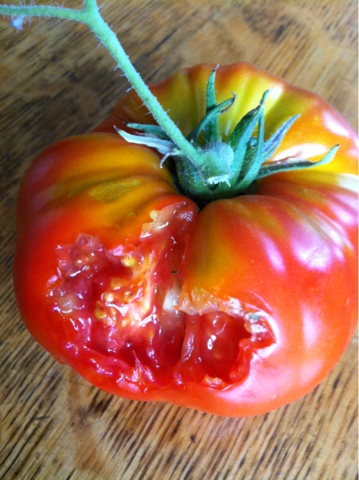
Our first tomato of 2012, a Black from Tula heirloom variety that we picked on July 11, was so big that we could not get it off the vine without cutting it in half! And we still lost the branch that the tomato had engulfed as it grew! The fruit ripened well ahead of usual for our urban garden, thanks to the unusually warm spring. Last year, we picked our first ripe tomato, a Cherokee Purple, on July 28th.

Friday, June 8, 2012

How to fertilize tomato plants

Ready for summer! By July this space will look like a jungle!
What a season 2012 is turning out to be! By Memorial Day we had all of our crops in their pots, ready to bask in the sun. The warm spring inspired us to get our seedlings started early. We're already reaping rewards. Our tomato and green pepper plants are sprouting fruit well ahead of their usual patterns, the cucumber vines are looking mighty healthy and the lettuce is going strong. We could be harvesting tomatoes come July. Speaking of tomatoes, we've added Jobe's Fertilizer Spikes to the pots. Buried in the soil, the sticks offer the proper mix of nutrients (a three to one ratio of phosphorous to nitrogen and potassium,) last for six weeks, and help the plants absorb calcium. The point is to avoid the dreaded blossom-end rot, a black, leathery scourge that often shows up on the blossom end of the fruit early in the season and renders it inedible. Another trick is keeping the plants consistently watered. We may try mulching so the soil doesn't dry out in the heat. We've added the spikes to our pepper plants as well. Next challenge: getting rid of the aphids on our eggplants!
Our first pepper
The fertilizer spikes

Thursday, May 24, 2012

Tomato surprise


Seed packets from Tomatofest.com
 This is a season of experimenting for NYC Gardener. Every year for the past six seasons, we've planted Brandywine and Cherokee Purple tomatoes along with several other varieties like Aunt Ruby's German Green and Chocolate Stripes. Last year, we didn't even buy new seeds, opting to repeat 2010's choices. This year we're going rogue. We have skipped our standard bearers all together to try out six new varieties. We went to our favorite heirloom seed site TomatoFest and looked through dozens of descriptions for tomatoes that might be just as delicious but easier to grow. I do love the Brandywine and Cherokee beefsteaks, but they take a long time to mature, so the plants are not as productive as they could be. The fruit gets so heavy on the vines that they're at risk to the windy conditions we get on our terrace. Heavy rain often causes cracking. So, this year, we decided  to go for varieties that mature a bit earlier and grow a bit smaller. We love green heirlooms, so we chose Green Zebra, a tomato served at Alice Waters' Chez Panisse. We wanted a Roma tomato to make great sauces and the Pantano Romanesco sounded like a hearty and flavorful option. We also picked one of Tomato Fest's top 10 for 2012, the Black from Tula, a Russian import with a smokey flavor. We didn't entirely turn our backs on the beefsteak. We're trying out Neves Azorean Red, "the ultimate sandwich tomato," advertised as tasty, disease resistant and productive until a frost. The only repeat is the Angora Super Sweet cherry, which we planted a few seasons ago and very much enjoyed. Last on our list is Kellogg's Breakfast, an orange beefsteak that came as a bonus from Tomato Fest. It's said to be sweet, tangy and nearly seedless. If all goes well, we should have a bang up crop. Even more amazing, all our plants are out in their pots and basking in the fresh air, more than a week ahead of our usual schedule. So, here's to a season of change!
Tomato in the pot